






|
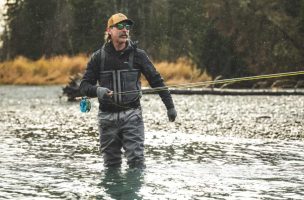
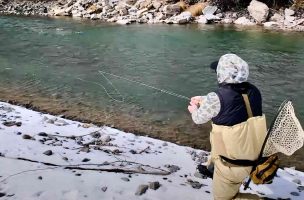
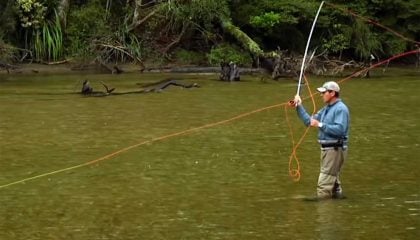
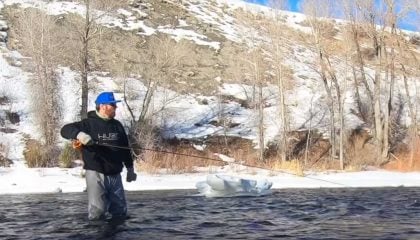
The Roll-Cast Pickup is one of the most useful techniques in fly casting. Roll cast to lift your line off of the water, then begin your backcast as the line straightens out. This greatly speeds up fly line pickup and delivery.
![]() WATCH R.A. Beattie's short film on the magic of Lake Powell smallmouth bass. |
||||||||||
Fly Fishing Gear
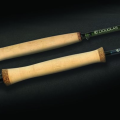
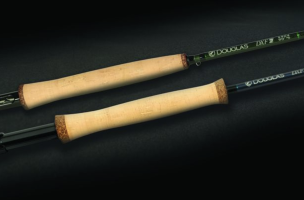
MidCurrent's 2009 New Fly Fishing Product Review
ONCE A YEAR at MidCurrent we're swamped with new product info. It almost always happens in September, because that's about the time of the annual Fly Fishing Retailer show, when shop owners are enticed to order all the goodies they'll need for spring. Sorting through it takes effort: a trip to Denver, uncountable emails and calls, and perhaps most challenging of all, getting manufacturers to explain exactly what they mean by words like "fishability" and "stump-pulling power." The result, though, is that we end up with a guide that even we refer to for the next nine months or so, until the cycle begins again.
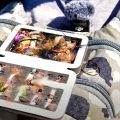
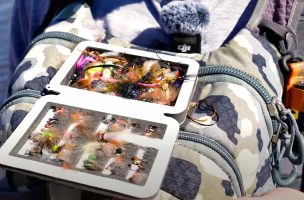
In "Four Feet of Anything" we cover new fly rods, fly reels, fly lines, fly boxes, luggage and packs, waders, tools, eyewear and accessories. Between the product news, prices and design announcements we hope you'll find something of value in our annual new gear wrap-up.
Fly Fishing Gear: Fly Rods
How to Choose a Fly Rod
LET'S ASSUME the rod is built to handle the right fly line exactly. It casts well in close, and it has the backbone to cast well at long distances. This rod is said to have the right "load" characteristics for the specified line. A rod manufacturer can then customize this rod's design by deciding where they want the rod to bend the most or the least. Making the rod flex or bend in the tip, mid-, or butt section of the rod can be used to further define the rod for the caster, either to match individual casting styles, or to match the needs of specific fishing situations.
Fly Fishing Books
The Muskie Top-Water Retrieve
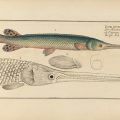
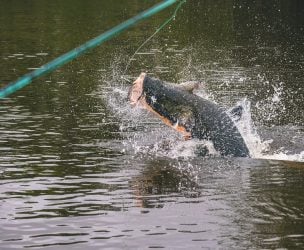
CATCHING A MUSKIE on a top-water fly is one of the most exciting and visually intoxicating events in all of fly fishing. Although I've fished around the world for many different and exotic species, for me nothing compares to the sight of a large muskie aggressively pushing a V-wake while following my popper across the surface, kicking up water with splashes of its tail, or blasting it from below and jumping sky-high with my fly sticking out of its mouth.
As nerve-wracking as this fishing can be, it's also a productive way to fly fish for muskies under the right conditions and with the right techniques. One of main the reasons it's effective is the muskie's shallow water and surface-feeding orientation through much of the peak warm water season. Depending on water temperatures and regulations where you fish, the top water popper can also be used with confidence as early as March and as late as November.
Fly Fishing Knots
Lefty Kreh Ties the Non-Slip Mono Loop
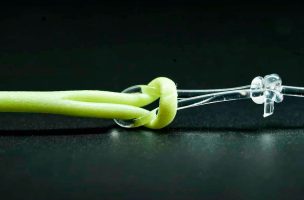
A LOOP KNOT is one of the most useful knots in fishing. A loop in the line allows the lure or fly to be more active during the retrieve. Anglers have used loops in monofilament and wire for decades, but most loop knots have some disadvantages. First, the tag end of most loop knots protrudes either outward or forward. This stub, even if very short, will tangle a thick tippet and often catch grass in the water, spoiling the retrieve. Second, most loop knots are not as strong as the line they are tied with and cannot be adjusted to loop size. Finally, many loop knots can be tied only in fluorocarbon or monofilament and not in braided wire.